
David Rogers Webb’s Latest Update: The Reckoning That Follows Hubris (PT 2)
Part Two of The Great Taking Revisited Series Is a Conversation With David Webb

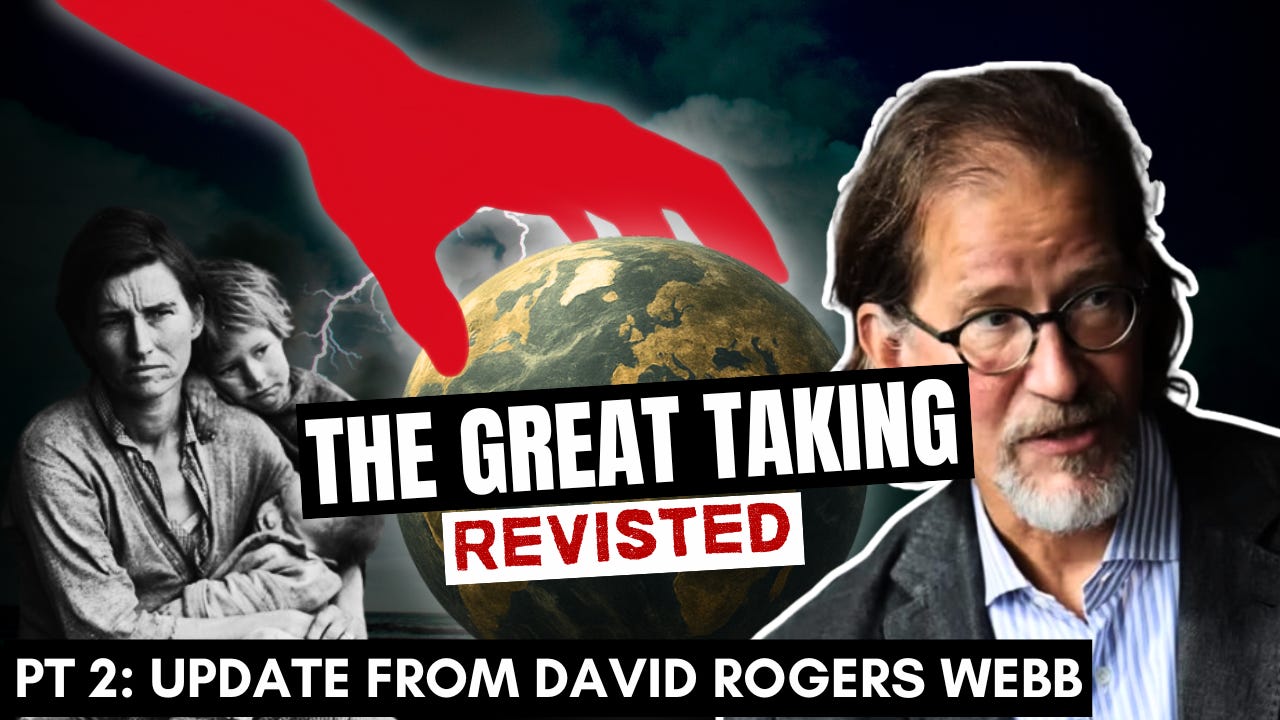
In Part One, I revisited how I personally became involved in the Great Taking early in its publication. From then on, it became an important part of my research and a recurring theme in my updates. Its influence reached well beyond my content, however, including shaping the personal choices I made to prepare for the difficult years ahead. I wasn’t the only one. Everyone who took the time to truly understand the Great Taking was affected by what they learned, and the responses that followed part one in this series reminded me of just how many people the book has impacted, not to mention how highly David and his work are regarded in the alternative media.
Clearly, awareness of the Great Taking has grown substantially over the past 2 years, but it’s fair to say it never came close to reaching the consciousness of the general public. And in my opinion, it is unlikely ever to do so. In fact, even if it’s triggered, I’m not convinced the public would understand what had happened to them, or why, in the same way you would. One of the protests I hear most often about the Great Taking is: “They would never do it… because the people would revolt!” Whilst I don’t deny that revolt is a possible outcome of such a monumental theft of assets, to think it couldn’t be framed in a way the public would accept—without sparking a revolution—is to ignore history.
Covid gave us all a taste of just how powerful prolonged bouts of isolation, fear, and propaganda can be in shaping the mass mind. If you had stood on a stage in front of 100,000 people in 2019 and described what they would soon believe, accept, do, and comply with, I’m convinced over 90% of them would have laughed at you. And yet, the vast majority fell in line—and even today, when so many of the lies have unraveled so spectacularly, most people still refuse to face up to what really took place. I would imagine the Great Taking, if enacted, would be veiled behind a similar set of lies, social controls, and subterfuge.

Loneliness, the common ground for terror, the essence of totalitarian government, and for ideology or logicality, the preparation of its executioners and victims, is closely connected with uprootedness and supefluousness which have been the curse of modern masses since the beginning of the industrial revolution…what prepares men for totalitarian domination in the non-totalitarian world is the fact that loneliness, once a borderline experience usually suffered in certain marginal social conditions like old age, has become an everyday experience in the evergrowing masses of our century.”
—Hannah Arendt
The Covid protocols were designed by teams of social engineers and psychologists who were given a mandate to terrify the populace, embed a narrative, and control their behavior. They succeeded. The reality is that with the advent of the mobile phone and social media, an emerging technocracy possesses an almost total window into the mass mind. This not only allows them to shape the majority’s thinking with precision, but also ensures that if a revolution ever began to emerge, they’d detect it long before even the would-be participants were conscious of it. At that point, they would simply crush it or divert the energy elsewhere—something that has, in fact, already been prepared for.
Statistically, the demographic most likely to revolt in any society is young adults. Yet today’s young adults are predominantly left-leaning and supportive of wealth redistribution. It's entirely possible they would celebrate boomers losing substantial amounts of their wealth, rather than revolt against it and rally in their defense. A 2019 Cato study reinforces this: the majority of Americans under 30 (53%) already favor redistributing wealth from the rich to the poor. It’s reasonable to assume that sentiment has only grown stronger in the years following Covid. In contrast, just 20% of Americans aged 65 and older supported redistribution.
With this in mind, it’s easy to imagine young people being swayed by a narrative that frames the loss of assets as a sacrifice for the common good. In reality, of course, everyone would be losing together. Were the Great Taking ever to take place, I expect the population would eventually be offered some form of deal, or rescue package, to smooth over the collapse—UBI, digital food stamps, selected debt forgiveness such as student loan debt, promises of continued assistance. And if you’re hungry, frightened, and isolated… what are you realistically going to do?
The function of propaganda does not lie in the scientific training of the individual, but in calling the masses’ attention to certain facts, processes, necessities, etc., whose significance is thus for the first time placed within their field of vision.
The whole art consists in doing this so skillfully that everyone will be convinced that the fact is real, the process necessary, the necessity correct, etc. But since propaganda is not and cannot be the necessity in itself, since its function. . . consists in attracting the attention of the crowd, and not in educating those who are already educated or who are striving after education and knowledge, its effect for the most part must be aimed at the emotions and only to a very limited degree at the so-called intellect. . . .
The art of propaganda lies in understanding the emotional ideas of the great masses and finding, through a psychologically correct form, the way to the attention and thence to the heart of the broad masses.
—Adolf Hitler, Mein Kampf
For these reasons, I don’t personally put much weight into the idea that fear of reprisals will be enough to stop them enacting the Great Taking. At least not at this point, given the lack of general awareness and near total fragmentation that exists in society. The only way to truly prevent it would be for the mechanism itself to be dismantled, given that it is an automatic process that will activate in a crisis of sufficient magnitude. I wish I could say the outlook on this being achieved is positive—but that simply isn’t the case.
As mentioned in part one, every attempt in the U.S. to reform the UCC has either stalled or been blocked outright—and in Europe, there isn’t even a legal route to stopping the Taking in the first place. With this in mind, I recently had lengthy conversation with David Rogers Webb, to find out how he views the landscape two years on from its release: what has changed, what concerns him most, and what message he believes people need to carry with them as we head into 2026.
Despite speaking with David routinely since the release of the book, even I was surprised by how much his perspective has shifted in recent months. What follows are the key points from that conversation, along with some of my own reflections and an update from Matt Smith.