
Dave Ramsey Told Millions to Avoid Gold. He Was Spectacularly Wrong
An Expose On The Protectors of the Ponzi Scheme Part 1: Dave Ramsey.

Dave Ramsey.
Where to start?
Many of you will know Dave through his nationally syndicated podcast, The Ramsey Show, which has been kicking around in various forms for three decades. The basic premise is simple: people call in with financial questions, and Dave answers them. Quite frequently, he also ridicules them for daring to ask a question—even though that is literally the entire point of the show. For people to call up for advice.
In Dave’s world, the idea that “there is no such thing as a stupid question” is null and void. But few questions appear to enrage him more than someone asking whether they should invest in physical gold or silver.
Over the years, plenty have tried. Each time, they were humiliated by Ramsey for daring to ask what he clearly considers to be the dumbest question of all. “Why the hell would you want to do that?” Dave screamed at one caller in 2014 after the man asked whether he should place some of his savings into gold bullion.
Dave’s rationale for dismissing gold is always the same: it is “just a commodity,” and buying it is “pure speculation.” Since that 2014 tirade, however, gold has risen by roughly 250%. That works out at an average simple return of around 21% a year, or approximately 11% compounded annually.
And yet Dave’s view has not changed.
As gold continued to rise, callers repeatedly gave him the opportunity to reconsider. Had the evidence changed his mind? Could gold perhaps be more than “just a commodity”? Was there something important he had missed?
Apparently not.
Instead, Ramsey continued answering the question with the same contempt and certainty, using it as another opportunity to flex his financial muscles, belittle the caller and make them feel small.
It is not simply that Dave made a bad call in 2014. Everyone gets things wrong. It is that gold went on to prove him wrong for another decade, and he still refused to reconsider the argument.
Dave has not merely been wrong about gold. He has insisted on remaining wrong about it for more than two decades. That demonstrates not only that he does not understand what he is talking about, but that he is also deeply disingenuous.
Ramsey told people not to buy gold at $500 an ounce. He told them not to buy at $1,000, $1,500 and $2,000. Then, in 2023, Dave went out of his way to warn his listeners that whatever they did, they should stay the hell away from gold.
The title of the YouTube video was: Why You Shouldn’t Be Fooled by “Gold-Buying” Headlines!
Below is an abbreviated transcript of the conversation.
Caller: I’m over 70 years old, so in about a year and a half or two years, I’m going to have to start taking money from my 401(k)—automatic payouts that the government requires.
Dave Ramsey: Yeah, your required minimum distributions.
Caller: Right. I don’t use that money. It just sits there. It was making money under the Trump administration. It’s kind of losing money right now. Anyway, I don’t really know what to do with that money because I don’t need it, but my gut feeling is to invest it in gold.
Dave Ramsey: No, no, no, no. We don’t put anything in gold. No.
If you don’t need it and you want to let it sit somewhere, let it sit in a good mutual fund. That’s fine.
Caller: That would do better than gold?
Dave Ramsey: Oh, absolutely. I own some gold cufflinks, and that’s the only gold I’ve got.
Caller: Okay. I just don’t want to do anything risky at this point.
Dave Ramsey: Gold is much more risky. Gold is much more volatile. If you look at the price of gold on a chart, it’s way up and way down—much more than the stock market. It is a lot riskier, and it does not yield. The average annual rate of return on gold sucks.
Caller: Really?
Dave Ramsey: Yeah, it’s awful.
Caller: I don’t know that much about it. I’ve just heard that gold was a good investment.
Dave Ramsey: Yeah, usually from people who don’t have any money.
The video has now been viewed more than 200,000 times, and its timing was impeccable.
At the time, gold was trading at a little under $2,000 an ounce. Bear in mind, it had already risen by over $1500 dollars since Dave first began warning people to stay away from it.
What interests me most about the call, is that Dave went out of his way to issue this special warning, right before gold’s major breakout. His message was clear: if you started seeing gold in the headlines, you absolutely should not buy it, because gold is a “risky,” “volatile” and “speculative commodity” akin to oil, wheat or copper.
This warning came immediately before one of the largest moves in gold since the last great financial reset of the 1970s, when the price increased 23-fold in just ten years. Meaning it was literally the worst possible financial advice he could give, at the worst possible time.
Unfortunately for them, I imagine a great many of Dave’s listeners, with his bad advice still echoing in their ears, failed to participate in the first wave of this bull market. Appropriately, the top-rated comment beneath the video, with more than 500 likes, reads:
“In three years, I made 70% on my gold.”
Another simply says: “Well, this aged like milk.”

But knowing that Ramsey has been pushing the same line for more than 20 years, and has stubbornly refused to update either his thesis or his knowledge on gold, the question becomes: why? Is it just ego?
Or could there be another reason for it?
Perhaps, while we are at it, we should also ask how Dave Ramsey went from bankruptcy in 1986 to becoming a billionaire financial guru whose company reportedly brought in $300 million in 2025 alone.
My view is simple: you do not reach that level of wealth, influence and mainstream exposure unless, somewhere along the way, you are serving the system. Some of Ramsey’s advice may sound sensible on the surface, but as always, the devil is in the detail. And in Ramsey’s case, I believe something far more sinister is at work.
I listened to more than ten hours of Dave Ramsey in preparation for this article, so you do not have to waste your time doing the same. And once you listen closely, the omissions become impossible to ignore.
Ramsey talks endlessly about the toxicity of debt, yet never seriously examines what creates it. There is no discussion of fiat money. No explanation of how commercial banks create money through lending. No examination of the monetary system that requires debt to expand continually.
And perhaps most remarkably of all, he never talks about inflation—the mechanism quietly destroying the purchasing power of the very families he claims to be helping. Those omissions are not minor. They are the key to understanding whose interests Dave Ramsey’s advice ultimately serves.
In the following article I will breakdown the Dave Ramsey deception, and elaborate on what I am doing instead of following his advice.
Dave’s Advice on Debt
Before we examine the Seven Baby Steps Dave urges every listener to follow, we first need to understand the fundamental message underpinning his entire philosophy: debt.
Ramsey claims to approach personal finance from a biblical perspective. At the centre of that philosophy is an almost absolute hostility towards borrowing, frequently supported by Proverbs 22:7:
“The rich rule over the poor, and the borrower is slave to the lender.”
On this point, Dave and I agree completely.
Debt is antithetical to freedom. It is a claim against your future labor. The moment you borrow currency, a portion of every hour you work from that point forward already belongs to somebody else. Your employer might pay you, but the bank, credit-card company and mortgage provider are standing behind you with their hands out.
Debt also magnifies every financial crisis.
During the Great Depression, it was not falling asset prices alone that destroyed people. It was falling asset prices combined with debt.
As property and land values collapsed, many people were left owing far more than their assets were worth. This is one of the main reasons so many family farms were lost. Farmers were trapped with debts they could no longer service, while widespread bank failures made refinancing almost impossible—even for those who still had the income to meet their obligations.
The result was foreclosure and seizure of the collateral. The same mechanism remains in place today, only the mountain of debt is vastly larger, and the assets can be taken with far greater ease.
At the end of the first quarter of 2026, total American household debt stood at an astonishing $18.8 trillion. Mortgage balances alone accounted for $13.19 trillion, while credit-card debt stood at approximately $1.25 trillion. The average American carrying credit-card debt owed roughly $6,500, often at interest rates above 20%.
Debt is a cancer that has spread across the entire world. Every currency in use today, what we save in, spend in, and are paid in, is literally debt.
So when Dave tells people to stop borrowing, cut up their credit cards and escape consumer debt, he isn’t wrong. I have no argument with the principle. Where I begin asking questions is over what happens next—and who ultimately benefits from the path he prescribes.
When Ramsey—or one of his Ramsey Show “experts”—convinces a struggling family to work three jobs, sell everything they own and repay every last cent of unsecured debt, the family may benefit from escaping the interest payments. But let us not pretend the lender does not benefit enormously as well. A debt that might otherwise have become delinquent, been renegotiated or even discharged in bankruptcy is instead repaid in full.
What begins as “get out of debt” quickly mutates into something more toxic. People are told to sell essential assets, downgrade reliable vehicles and abandon investing in their own families future—all so an unscrupulous lender receives its money slightly faster. The borrower must surrender everything. The creditor, meanwhile, is treated as though its claim is sacred. Even if default is an option, Ramsey sides with the creditor and tells his callers to pay them, even though he himself, went bankrupt in 1986.
Despite the show’s constant attempt to frame callers as the architects of their own misery, many are not reckless or irresponsible. They are simply being crushed by the system.
One recent caller was a prime example of this. He was a hard working father of four putting in 80 hour weeks in law enforcement while his wife stayed at home to care for their four children. He was not drowning because he was lazy, careless or wasting money on luxuries. He was doing everything the system tells a man to do: working relentlessly, supporting his family and even taking on a side hustle doing security work just to get by.
Yet despite all of that, he was barely surviving. We know why. The Ramsey Show apparently does not.
His wages had been hollowed out, the cost of supporting a family had exploded, and the fiat system was debasing his earnings faster than he could increase them. This was not a man who had failed. This was a man being bled dry despite doing everything right.
And what was the advice? Sell your vehicle. Buy an old banger. Find another job on top of the 80 hours you already work and the side hustle you already have. Spend even less time with your wife and children. Become an even more obedient pawn in the debt ponzi game.
There was no discussion of why a hardworking father could no longer support a family on a full time salary. If this man had been supporting the same family in 1970, he would almost certainly have enjoyed a comfortable standard of living. In 2026, after working himself into the ground, he was approaching breaking point.
The Ramsey Show’s answer?
Work harder, pleb!
The Seven Baby Steps: Who Really Benefits?
At the heart of Dave Ramsey’s entire financial philosophy are what he calls the Seven Baby Steps—a supposedly simple path designed to take ordinary families from debt, stress and financial insecurity to solvency and, eventually, wealth.
On the surface, much of it sounds sensible. Pay off debt. Build an emergency fund. Save for retirement. Clear the mortgage. It is easy to understand why millions of people have embraced it.
But once you look beneath the surface, a different picture begins to emerge. The Seven Baby Steps may help people become more disciplined, but they also keep them firmly inside the financial system Ramsey appears to be protecting. Your savings remain in the bank. Your retirement wealth is handed to Wall Street. Your investments remain exposed to custodians and placed entirely withing the debt-based monetary system itself.
So let’s examine each of the Seven Baby Steps in turn—and expose how Ramsey’s supposed roadmap to financial freedom ultimately funnels your wealth straight back into the pockets of parasitical bankers, replacing debt dependence with investing in debt dependence.
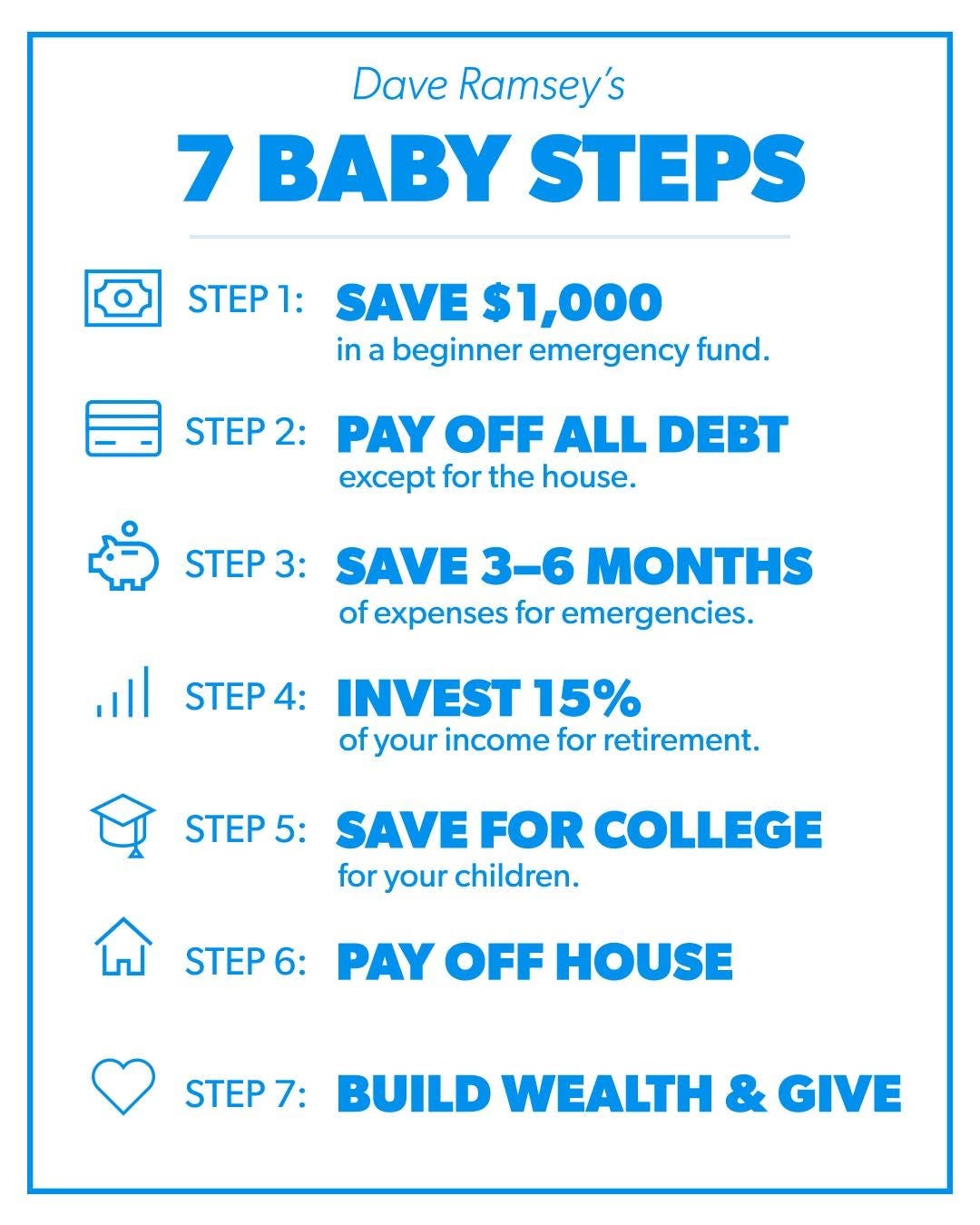
Baby Step 1: Save $1,000 for a Starter Emergency Fund
Dave’s first Baby Step is to save $1,000 in cash before beginning the aggressive repayment of debt. The purpose is to prevent a relatively minor emergency—a broken appliance, unexpected bill or vehicle repair—from forcing the borrower straight back onto a credit card.
There is nothing objectionable about building an initial cash reserve. The problem is that $1,000 is no longer a meaningful emergency fund. It might cover one modest repair, but it will not carry a household through a job loss, illness, a major home expense or any serious disruption to the financial system. After years of inflation, the figure has become almost meaningless.
More importantly, Dave’s idea of emergency liquidity begins and ends with currency. It is supposed to protect somebody from a financial emergency but assumes that the currency, banks and payment system themselves remain perfectly functional. It’s completely blind to counterparty and systemic risk.
My approach for those just starting out is working towards my 3-4-5 Strategy: three months of salary held in cash, four months in silver and five months in gold. It is designed to provide a family with genuine protection against a major crisis.
It may take longer to build than Dave’s $1,000 emergency fund, but it can be accumulated gradually over time and will actually create some meaningful protection. It also protects against inflation, providing not just emergency liquidity, but an initial form of investment in the metals. Sorry Dave!
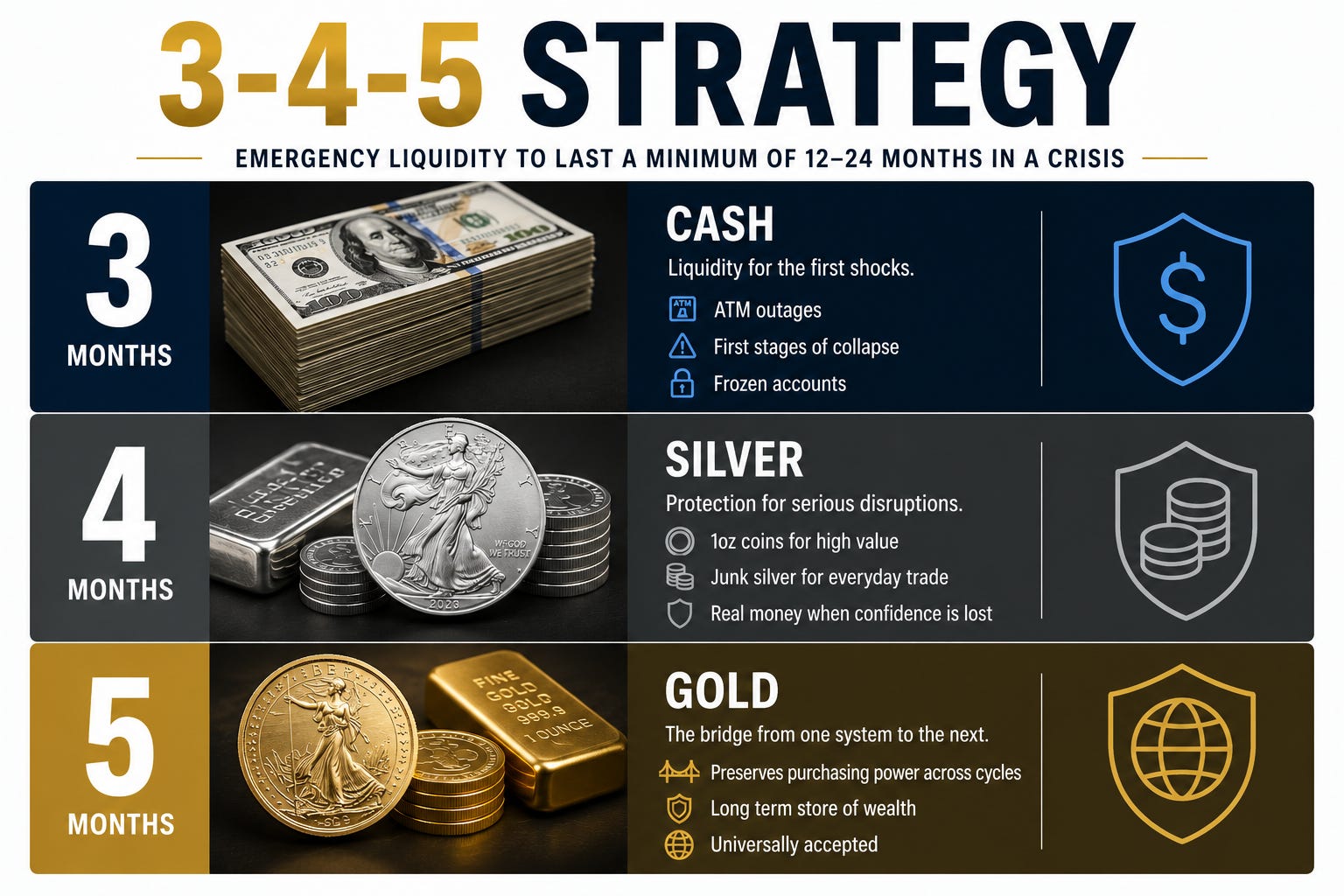
Mike’s 3-4-5 Strategy Explained: Each part performs an important function. Cash is trash over the long term, but it remains important during the early stages of a financial shock, or during an intermittent disruption in which shops and businesses are stilling willing/ able to accept the currency. Three months is sufficient, and will see you through most crisis situations.
Silver forms the second layer. If electronic payments stop working, banks restrict withdrawals or the currency begins to hyperinflate, silver provides a practical medium for smaller transactions, trade and barter. You are unlikely to use an ounce of gold to buy groceries, but fractional silver can bridge that gap. Especially with local farmers and food producers who have no choice but to sell their food, but could well be unwilling to accept currency if it becomes obvious it’s entering hyperinflation.
At that point, they will accept real money only.
Gold is the final layer and the foundation beneath the entire structure. It is not there to pay next week’s electricity bill. It is the final bastion of wealth.
If you manage to protect it, gold becomes the bridge between the existing monetary system and whatever replaces it. In a worst-case scenario, it remains the most trusted and desired form of money, immediately convertible into any other currency, anywhere in the world. In that sense, it is the ultimate form of liquidity.
Between the three, you have every base covered for at least 12 months of disruption.
It is also important to remember that spending falls sharply during a genuine crisis. Holidays, restaurants, new vehicles, subscriptions and most discretionary purchases disappear. Three months of ordinary salary held in cash could therefore fund six months or more of essential expenditure, while the silver and gold reserves could be stretched in the same manner. So whilst my 3-4-5 Model contains twelve months of salary, under crisis conditions it could feasibly provide two years or more of genuine liquidity.
Compare this with Dave’s $1,000—which he now advises people to keep in a bank savings account. In other words, his emergency fund is designed to cover the financial equivalent of a broken washing machine, and remaining exposed to a banking system that could freeze or confiscate it.
Baby Step 2: Pay Off All Non-Mortgage Debt
Dave’s second Baby Step is to clear all non-mortgage debt, beginning with the smallest balance and working upwards. As already discussed, I broadly agree with his philosophy of getting rid of debt. Consumer debt strips people of their independence, consumes future income and leaves them vulnerable to creditors at precisely the moment they most need flexibility.
It is worth reiterating, however, that much of the debt Ramsey urges people to repay is unsecured. If the borrower defaults, the bank is forced to absorb a loss on a loan it chose to make. Sometimes, that is exactly what should happen. Ramsey’s approach instead demands that the borrower sell possessions, slash spending and work additional hours until the lender is repaid in full. The borrower is expected to sacrifice everything to protect the creditor from the consequences of its own decision.
What is right will differ from one person to the next. For most people, escaping consumer debt is one of the best things they can do. But Ramsey strips the issue of its moral context entirely, even while claiming to follow a “scriptural approach” to finance.
The Bible warns repeatedly about usury, debt bondage and the use of financial power to reduce human beings to servitude. The New Testament even speaks explicitly of the “synagogue of Satan.” Yet Ramsey has almost nothing to say about the morality of the lender, the corruption of the money changers or the deliberate use of debt to enslave entire populations.
Nor does he ever explain the debt mechanism itself: why nations must borrow their own currency into existence, then repay that debt—with ever-rising interest—to private bankers.
Has Dave ever read The Creature from Jekyll Island? I doubt it. Does he ever engage with the forces driving the global debt explosion? Does he ever ask who creates the money, who collects the interest, or why the entire system requires exponentially more debt merely to remain standing?
No, my friends, he does not.
Because Dave will condemn the borrower all day long, but he does not dare confront the forces operating behind the system. Instead, whether knowingly or not, he protects them.