


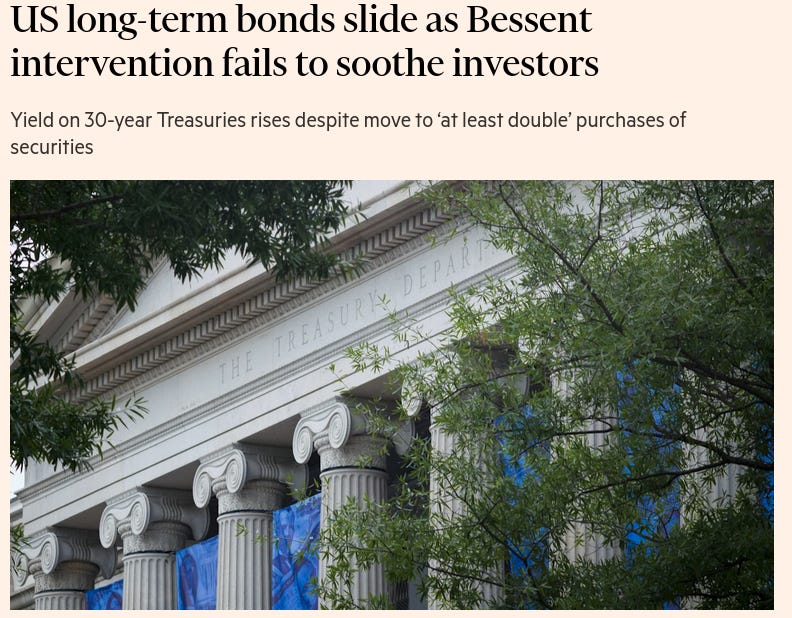
Yesterday Treasury Secretary Scott Bessent proudly announced that the US was abruptly increasing the scale of its intervention in the US bond market, stating that “we will at least double the purchase of bonds.”
Uh oh.
This comes only weeks after he once again tried to reassure us that America’s gold is still sitting safely in Fort Knox. The two are connected. Despite the US dollar no longer being backed by anything but more debt, the idea that America still has its gold serves as a sort of security blanket for frightened bond holders.
But that bluff is wearing increasingly thin. In the same week that the US announced plans to ‘support’ their bond market, US debt topped $40 trillion dollars. It’s hardly reassuring, and each new announcement only reinforces the sense that, behind the scenes, things are deteriorating—and fast.
Bessent’s smug, overconfident style may have worked for a while, but he is quickly learning that bluffing your way through catastrophe does not work nearly as well in the debt markets as it does in geopolitics.
As an aside, have you ever seen anything more cringe than this?!
Put simply, when every other week requires you to announce a new level of ‘intervention’, and take another imaginary trip to Fort Knox to pretend-look at the gold, market confidence starts to evaporate rather quickly. To misquote Shakespeare: ‘the ladyboy doth protest too much.’
With a slew of unexpected maneuvers this year, Scott Bessent has emerged as the most interventionist Treasury secretary in financial markets in decades — putting his credibility on the line in an effort to quell a potentially damaging rise in US borrowing costs.
—Yahoo Finance, Bessent Becomes Most Interventionist Treasury Chief in Decades
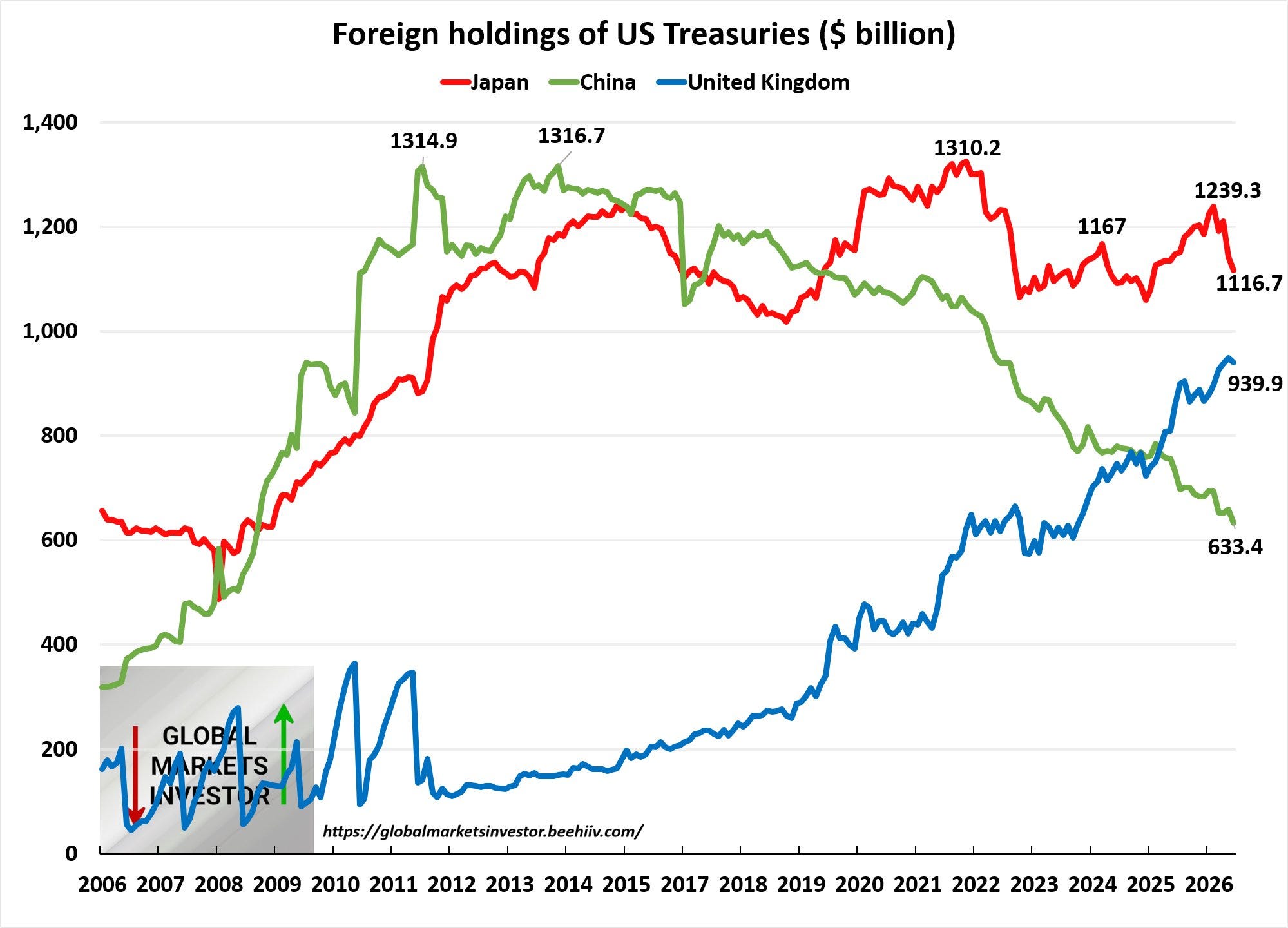
Obviously, it is not just America. The entire system is now beginning to seize up after decades of radical central-bank intervention designed to prop up asset prices. Just last week, Japan hit the headlines after being forced to repeatedly intervene in its own currency, as the yen began another phase of meltdown.
As we know, the US was then forced to step in with emergency dollar liquidity. Why? Because Japan holds an enormous amount of US debt, and if its own sovereign debt crisis worsens, one of the quickest ways for it to raise dollars is to start selling those Treasuries. That would create an even bigger problem for America.
So the US effectively moved to give Japan access to dollars, reducing the pressure on it to dump US debt into an already fragile bond market.
Washington fears that Japan could try to prop up the yen by selling some of its $1 trillion-plus reserves of US Treasury bills – which would have a destabilising effect on America’s public finances and the dollar. It would push the cost of serving America’s national debt even higher, and a weak dollar would also have inflationary consequences in the US.
—The Independent, What’s the Japanese yen crisis and why does it affect Britain?
The two nations now share the same problem and both are trapped between a rock and a hard place: allow the bond market to implode as foreign holders dump the debt, or defend it through increasingly exotic interventions and watch the world dump your currency instead.
Heads you lose. Tails you also lose.
But because the US is the largest issuer of debt in the world, there is nobody coming to save them as they attempted—and failed—to do with Japan. Nobody, that is, except the Fed, which will soon have no option but to monetize the debt outright. Don’t fall for the Kevin Warsh tough talk rubbish, it’s all smoke and mirrors at this point.
Indeed, the old mantra of “our dollar, your problem” has finally flipped as those chickens come home to roost. In essence, it is now a case of: other nations selling Treasuries, America’s problem. And markets are beginning to realize there are an awful lot of Treasuries out there available to sell.
It is not overstating it to say that the West is about to experience a sovereign debt crisis unlike anything anyone alive has seen. One that will ultimately be resolved with a complete financial restructuring. The Great Reset. These ever more frequent interventions are certainly not fixing anything, because they do nothing to cure the underlying disease. Which, spoiler alert, is not chickenpox.
It’s plague.
Adding more plague to the plague does not improve the situation. Those on the inside are finally beginning to understand what many reading this already knew: this system is living on borrowed time. Just look at the US 30-year yield today. It has already resumed its climb higher just 24 hours after it was announced the US would be stepping up their purchases.
As a further kick in the teeth, gold soared 3.5% on the day as the Dollar Index collapsed. In other words, the intervention has failed. Money is moving out of dollars, out of US debt, and into gold. Clearly the ‘intervention’ has been rejected. The markets want more. Much more.
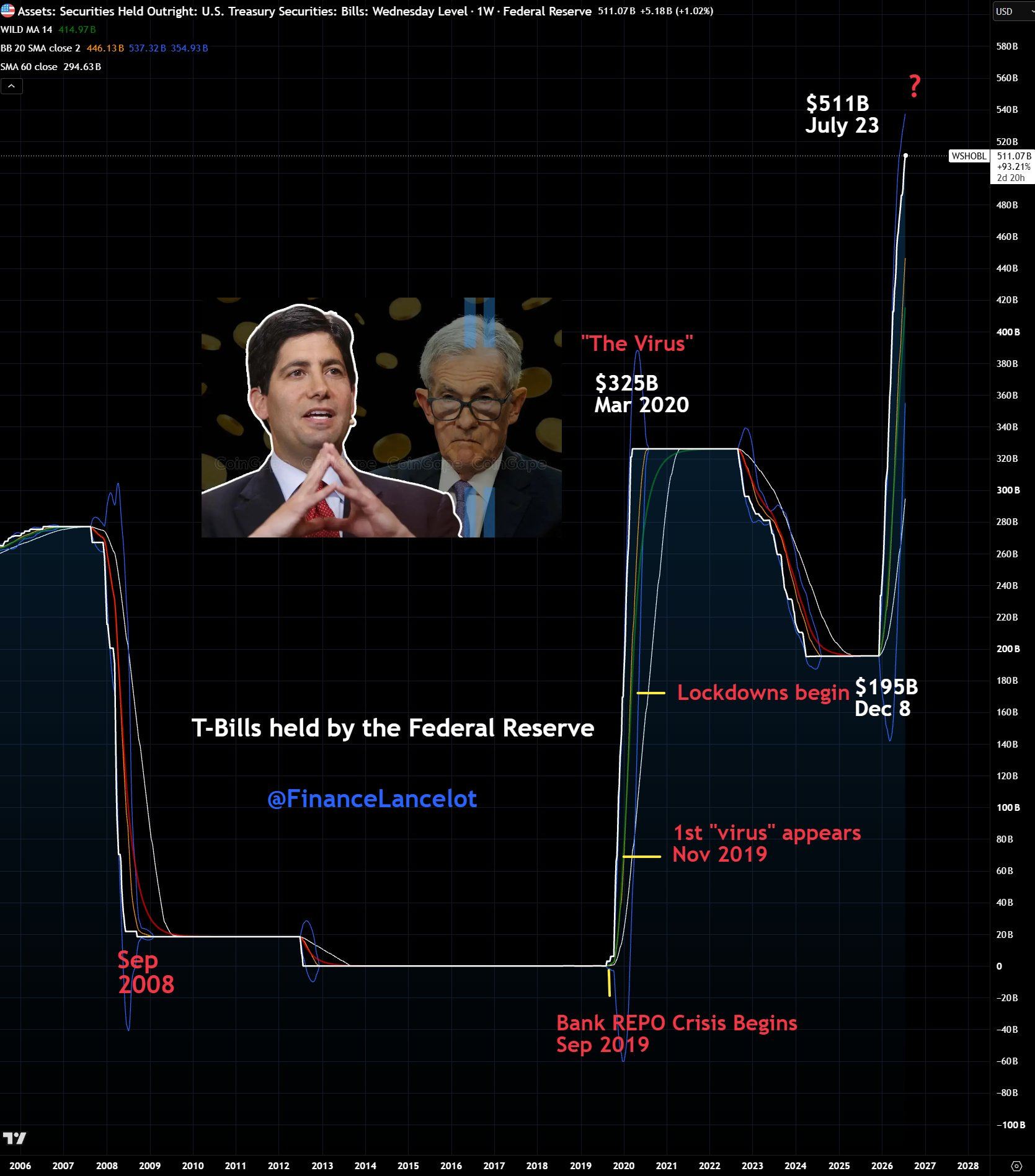
It is worth remembering that this latest intervention was not the first warning sign that things were weakening beneath the surface. In December last year, the Federal Reserve were already acknowledging that liquidity in the commercial banking system was tightening, before announcing it intended to increase its holdings of short-term T-Bills in response.
And increase them it did.
Those holdings soared from $195 billion in December to more than $511 billion by July. I warned about this months ago because the dynamic is almost identical to what we saw before the Scamdemic.
During the Repocalypse of September 2019, the overnight repo rate exploded from around 2% to as high as 10%. At that point, the Federal Reserve was forced to step in and inject liquidity into the system. One of the mechanisms it used was buy short term government securities. The fact that this mechanism is now back in play should be setting alarm bells ringing.
Of course, that was only the beginning, much more was needed. Enter the Scamdemic, and its massive fiscal response. So the question we should be asking is: are we now treading the same path? Is another major crisis imminent? I believe it is, and that all of these interventions we’re seeing now are merely the opening act of something much, much bigger.
I think we are in exactly the same place now. Their interventions are not enough and behind the scenes, they already know something massive is needed to give them cover for one final mega-print. QE, helicopter money, enormous bailouts—you name it. At this point, they need all of the above.
I believe this could well be the explanation for the completely artificial disruption in the Strait of Hormuz. It has been allowed to drag on for so long, that we are now guaranteed a crisis in the back half of 2026. The consequences have already bled into farming, the production of high-end lubricants and multiple areas of manufacturing.
To be clear, this was obvious from the get-go. When I called the top in oil a week before the market crashed 35%, it wasn’t because I thought the crisis was over. Quite the opposite. I said in that piece that I expected major shortages later this year, and that I believed much of this was likely by design.
So I am not surprised that all of these narratives are now converging: a fiscal crisis paired with an impending social crisis, just like in 2020. Because tremendous and extraordinary fiscal measures require a tremendous and extraordinary crisis to justify them.
So in this article, I am going to explain why I believe now is the time to prepare—and, more importantly, how I am positioning across metals, miners and beyond for what comes next. Nobody can predict the future exactly, but it should be obvious to anyone reading this that we have now hit almost every milestone you would expect to see before something nasty arrives.
So here are the things you need to know to make sure your portfolio is crisis-ready.